

Borrowing Instructional Methods, Techniques, Activities & Materials From Other MSSL Programs
by Thomas J. Diebold, Ph.D.
This article will describe how to “borrow” instructional methods, techniques, activities or materials from different Multi-Sensory Structured Language (MSSL) programs to enhance student performance (without inadvertently omitting critical skills or content). The design features of effective MSSL programs for students with reading difficulties can be described in terms of “what is taught” (scope & sequence of skills) and “how is it taught” (instructional methods, techniques, activities and materials).
MSSL programs are organized with a specific scope and sequence of skills that is intended be followed and completed to ensure that all critical skills and concepts are introduced, practiced and mastered. Switching programs midway through sequences can be problematic if critical concepts or skills are lost in the transition, due to differences in program sequences.
However, “borrowing” instructional methods, techniques, activities and materials while maintaining an effective program sequence can be most beneficial.
What is Taught (scope & sequence of skills)
• Phonology & Phonological Awareness (the sounds of the language)
• Sound-Symbol Association (letter-sound correspondences)
• Syllable Instruction (teaching specific syllable types*)
• Morphology (combining base words, roots & affixes)
• Syntax (sequence & function of words in sentences)
• Semantics (contextual meaning of words)
* The six syllable types (note: Stevenson sequence)
• Vowel Team (ex. nail)
• Open (ex. no)
• Vowel Consonant-e (ex. note)
• R-Controlled (ex. nor)
• Closed (ex. not)
• Consonant-le (ex. -ble as in noble)
All MSSL programs should ultimately cover the same concepts (scope), but often in a different order (sequence). Most Orton-Gillingham-derived MSSL program sequences (ex. Wilson Reading System, Patterns for Success, SPIRE etc.) will introduce the short-vowel sounds via the Closed-syllable type first, but follow different instructional sequences for the other syllable types and content. The Stevenson MSSL program has a very different sequence from the Orton-Gillingham-derived programs by introducing the long-vowel sounds via the Vowel Team syllable type first (since long-vowel sounds are easier to blend and segment compared to short-vowel sounds).
If your student is making consistent progress with an effective MSSL program, it is generally the best to complete the entire program (maintain the sequence) to avoid missing content. If you switch to a MSSL program with a different sequence, you may inadvertently fail to teach critical content.
As a retired instructional consultant, supervisor and director of special education, I occasionally encountered students being removed from a successful MSSL program before completing the sequence of concepts, and then struggling with gaps or “holes” in content mastery that inhibited later progress. This could occur when changing school districts, grade levels or MSSL programs. At times, the change would be made by a teacher who preferred a different program, was not trained in the prior program, or simply didn’t use an MSSL program.
Key Ideas: “If a program sequence is working, try to finish it. If necessary, try borrowing alternative methods, techniques or materials before changing programs.”
How It Is Taught (methods, techniques, activities & materials)
• Simultaneous Multi-Sensory (visual, auditory, tactile & kinesthetic)
• Systematic and Cumulative (sequence of easier elements before difficult)
• Direct Instruction (teacher directly teaches concepts – no “inferential learning”)
• Diagnostic Teacher (careful & continuous assessment of student responses)
• Synthetic & Analytic Instruction (“part-to-whole” & “whole-to-part”)
Fortunately, all well-designed MSSL programs based on Orton-Gillingham and programs like Stevenson feature these critical instructional elements. The simultaneous visual,auditory, tactile and kinesthetic methods are intended to overcome the visual or auditory memory deficits that students can evidence. The programs also feature mnemonic aids to memory in the form of letter-keyword-sound associations. However, the Stevenson program features extensive mnemonic strategies beyond letter-keyword-sound associations, to include mnemonics for sound production, letter formation, syllable type, affixes, spelling rules and more.
“Borrowing” Methods, Techniques, Activities & Materials from MSSL Programs Educators should ensure that students have had adequate practice to become “automatic” with decoding before moving forward in the sequence or contemplating changes to another program. At times, students will simply need extra practice. Another option to enhance student performance is the infusion of different methods, techniques, activities or materials from another MSSL program while maintaining the existing program sequence.
• Phoneme Cards & Tiles (various Orton-Gillingham programs)
Phoneme cards are individual cards, typically the size of playing cards or index cards, that have individual letters or letter combinations printed on one side in large print. The cards represent individual vowels, vowel digraphs or diphthongs, as well as individual consonants and consonant blends or digraphs. The cards are often color-coded to indicate vowels (often orange or salmon colored) and consonants (often white or cream colored).
The cards are used for drill or warm-up activities, as well as to demonstrate syllable concepts. Students can also manipulate cards (or smaller tiles) to visually and tactile-kinesthetically internalize concepts.
Cards and tiles are often magnetized to permit manipulation on vertical surfaces like magnetic white boards. Cards can also have information on the back for teachers indicating the letter-keyword-sound mnemonic. Sounds are usually represented by a phonetic alphabet symbol. Cards can be purchased, down-loaded or be made from index cards and colored markers (ex. black for consonants, red for vowels).
“Finger-Tapping” (Wilson)
Students tap their thumb to their index finger, middle finger, ring finger and “pinkie” in sequence to represent sounds in a syllable, while simultaneously voicing the individual sounds. This technique/activity can be used to segment, or separate a syllable (the whole) into the individual sounds (the parts) when reading/decoding or spelling/encoding. The student can then slide their thumb across each finger while voicing the individual sounds in sequence to blend, or combine the individual sound parts into the whole syllable.
• “Word Attack” (various Orton-Gillingham programs & Stevenson program)
Most word attack strategies in Orton-Gillingham based programs model sequential, left-to-right progression through each letter of a syllable. All word attack begins with the first letter, whether it is a vowel or a consonant. The student must hold in auditory sequential memory all letter-sounds that may occur before the vowel (sometimes up to three sounds), while simultaneously determining the vowel sound by recognizing the syllable type. At times, this simultaneous process can overload the auditory sequential memory capacity of the student.
“Seven Special Steps” Word Attack (Stevenson program)
The Stevenson program teaches students a seven step procedure that begins with identifying the vowel and syllable type before beginning the left-to-right progression through a syllable. Mnemonic clues (aids to memory) are used throughout the procedure to reduce retrieval errors and enhance blending skills.
1. Look at the whole word
2. Find the “friends” (vowel or vowels) & identify the syllable type by mnemonic
association
3. Sound-out the vowel(s)
4. Sound-out the initial consonant(s) to the left of the vowel
5. Blend the initial consonant sound(s) to vowel sound (to form a unit)
6. Repeat if necessary
7. Sound out final consonant(s) and blend into a complete word or syllable
The Seven Special Steps are systematically introduced in the Stevenson program and are summarized as reproducible handouts found in the back of various Stevenson manuals. The Seven Special Steps are particularly helpful for word attack and blending sounds into syllables/words with multiple consonants that may overwhelm the auditory, sequential “working” memory of students (ex. “streak” or “stretch”).
• Word Cards (various Orton-Gillingham programs & Stevenson program)
Word cards are typically used to facilitate decoding automaticity and to practice sorting words by syllable type. Non-phonetic words (ex. said, have) usually have a special color or marking to indicate that the word does not “sound-out”. Like phoneme cards, word cards can be used for drill or warm-up activities.
Vocabulary Option – “Definition Leaping” (Stevenson program)
Vocabulary can be practiced by adding definitions to the back of cards in order to play a game of “I have...Who has?” (definition leaping).
Using the following templates for definitions:
Noun (name word): A ___ is a ___. (A foal is a baby horse.)
Verb (action word): To ___ means to ___. (To weep means to cry loudly.)
Adj. (painting word): To be ___ means to be ___. (To be lean means to be thin.)
For a set of cards with words on the front side, corresponding incomplete definitions are printed on the back of a different card in the set, such as “A ___ is a baby horse.” After reading the incomplete definition, the student with the card reading “foal” states, “I have the word foal, who has the word for “To ___ means to cry loudly?” Stevenson refers to this activity as definition leaping.
Grammar & Syntax Option – “Word Barrels” (Stevenson program) Word cards can also be used for sorting words by part-of-speech/grammatical function into stacks or containers (like empty yogurt containers). Containers can be sequenced and labeled “Painting Words”, “Name Words” and “Action Words”. Cards can be removed from the stacks or containers to build grammatically-correct sentences (syntax). Ex.: “The lean foal weeps.” The sentences can be logical or silly. Stevenson refers to these containers as “barrels”.
• Affix Cards & Morphology (various Orton-Gillingham programs)
Similar to phoneme cards, affix cards can be used for teaching prefixes, suffixes (Latin or Anglo-Saxon origin) or for Greek-derived “combining forms” to build multisyllable words. Many affixes and combining forms carry meanings that aid in vocabulary comprehension (ex. “im” can mean “in”, “port” can mean “carry”, so the word “import” can mean “to carry in”). Changes in meaning or function of words by adding, deleting or changing affixes are functions of morphology.
• Syllable “Chopping” (various Orton-Gillingham approaches)
To assist with separating syllables in spoken multi-syllable words for spelling, the strategy of “syllable chopping” can be helpful. The student is shown how to extend one arm and make a chopping movement with the opposite hand down the arm.
Each “chop” represents an individual syllable. After chopping the entire word, individual chops after syllables are followed by “finger tapping” the sounds of the syllable. After tapping, the student can determine the corresponding letter for each sound, and write the letter(s) or select the appropriate phoneme cards or tiles.
• Pattern Marking (various Orton-Gillingham programs & Stevenson program)
Pattern marking activities enable students to visually internalize the elements of a syllable, including vowel position, syllable type and the vowel or consonant sounds determined by the syllable type and spelling rules. These pattern marking procedures are usually found in program teacher’s manuals or on video clips found on the internet. Instructors model the activity with narration (“thinking out loud”) and provide multiple opportunities for students to practice and “automatize”. Samples of pattern marking various syllable types can be displayed for students to reference.
• Spelling Rules (various Orton-Gillingham programs & Stevenson program)
English has quite a few rules for spelling. The number of rules and timing for introducing rules can vary significantly by program sequence. Most Orton-Gillingham based programs rely on rote memorization and guided practice for student mastery.
The Stevenson program relies on multi-sensory mnemonics (aids to memory) and guided practice, rather than rote memorizing complex rules. Stevenson spelling mnemonics are embedded throughout the program’s teacher’s manuals, but are easiest to reference from the Beginning and Intermediate Spelling Manuals. Instructors using Orton-Gillingham based programs can access the Stevenson spelling manuals to supplement rote-memory based instruction without compromising their program’s sequence.
Penmanship (various Orton-Gillingham programs & Stevenson program)
Most Orton-Gillingham based programs include penmanship instruction, or have references to “stand-alone” penmanship programs, such as Handwriting Without Tears, Big Strokes for Little Folks, or Loops and Other Groups. The Stevenson program has manuscript and cursive built into the program, as well as “stand alone” (Stevenson’s Letters, Stevenson’s Cursive Writing).
The use of mnemonics for vertical orientation (floor, ceiling, roof, cellar) is also accompanied by left or right directional mnemonics for horizontal orientation. Stevenson also provides recommendations for left-handed or right-handed paper orientation, as well as an instructional sequence that reflects common pencil strokes, similar to the penmanship programs mentioned above or implemented by an occupational therapist.
Grammar (Stevenson program)
Stevenson also embeds grammar into all three levels of the program. Students are systematically introduced to nouns, verbs, adjectives and prepositional phrases before transitioning to Stevenson’s Essential Grammar that completes all eight parts of speech and their functions. Students generate grammatically correct, complete sentences. Students should be at the third grade level or higher to begin the Stevenson’s Essential Grammar program as a “stand-alone” option.
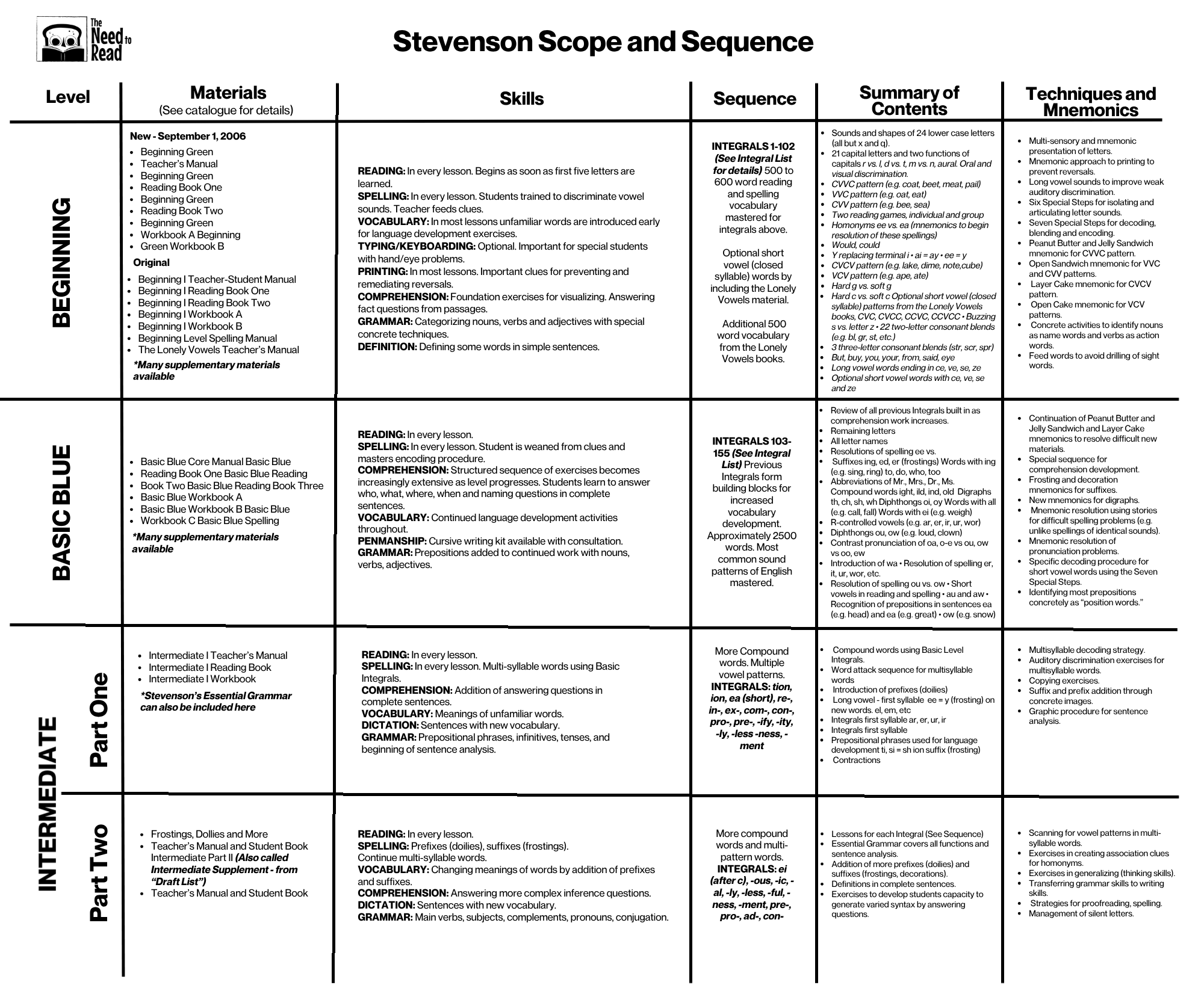
Stevenson’s Scope and Sequence
Dr. Thomas J. Diebold is a retired instructional consultant, supervisor, and director of special education with extensive experience supporting students in Multi-Sensory Structured Language programs, including Stevenson.