

Free resources to help you teach with confidence.
Download free guides and PDFs for using the Stevenson program in your classroom or tutoring sessions. More resources are coming soon through our subscription library.
Available now — no signup needed!
Download and use these resources with your students right away.
Not sure where your student fits in the Stevenson program? This guide was made for you.
Whether you are a classroom teacher, a reading specialist or a parent working at home, this free guide walks you through everything you need to get started with the Stevenson Language Skills Program for students in kindergarten through 5th grade.
Inside you will find:
How to figure out which level and path is right for your student based on their age and current skills
A clear explanation of Path 1 (Overlapping Strategy) and Path 2 (Beginning Green Level) so you know exactly where to start
How the Stevenson lesson structure works and what to expect in early sessions
An overview of how mnemonic clues and multi-sensory activities support struggling readers
Guidance on pacing and what progress looks like at each stage
Reading practice does not have to mean sitting quietly with a workbook.
This guide gives you practical, ready-to-use games and group activities designed specifically for students working through the Stevenson program. It covers how to set up activity centers so learning continues even when you are working with individual students, how to use the Group Game to maximize oral reading practice without losing anyone's attention, and printable games that reinforce vocabulary, vowel patterns and rhyming in a format students genuinely enjoy.
Perfect for small group instruction, reading centers or any time you need your students engaged and practicing independently while you redirect your attention elsewhere.
You already know something is wrong. You see it every day.
This free guide gives you the tools to finally do something about it.
Inside you will find a practical, no-fluff resource that walks you through how to identify struggling readers in your classroom (even the ones who have learned to hide it) understand the research behind structured literacy and what effective intervention actually looks like, recognize the signs of dyslexia, auditory processing disorder, ADHD and other reading challenges, and see exactly how the Stevenson Learning Skills Program fits into your school's existing structures in a way that is practical and sustainable.
This is not another checklist. It is a clear, honest guide written by educators who have been in the room with struggling readers and know what it takes to close the gap.
This assessment tool is designed specifically for students following the Stevenson Overlapping Strategy, the path that combines the Beginning Green Level with the Basic Blue Level for students in grades 3 and up who already know some letter sounds but are still struggling with reading and phonics.
Important to note: these are not placement tests. Every student using the Overlapping Strategy should start at Lesson One regardless of their pre-test results.
Two essential life skills. One practical, easy-to-teach guide.
Many students with learning differences struggle to tell time and read a calendar long after their peers have moved on. This manual gives you a clear, step-by-step approach to teaching both skills in a way that actually sticks.
It works for students being introduced to these concepts for the first time and for older students who have tried and failed with traditional methods. Each lesson lists exactly what materials you need, most of which you can make directly from the appendices included in the guide.
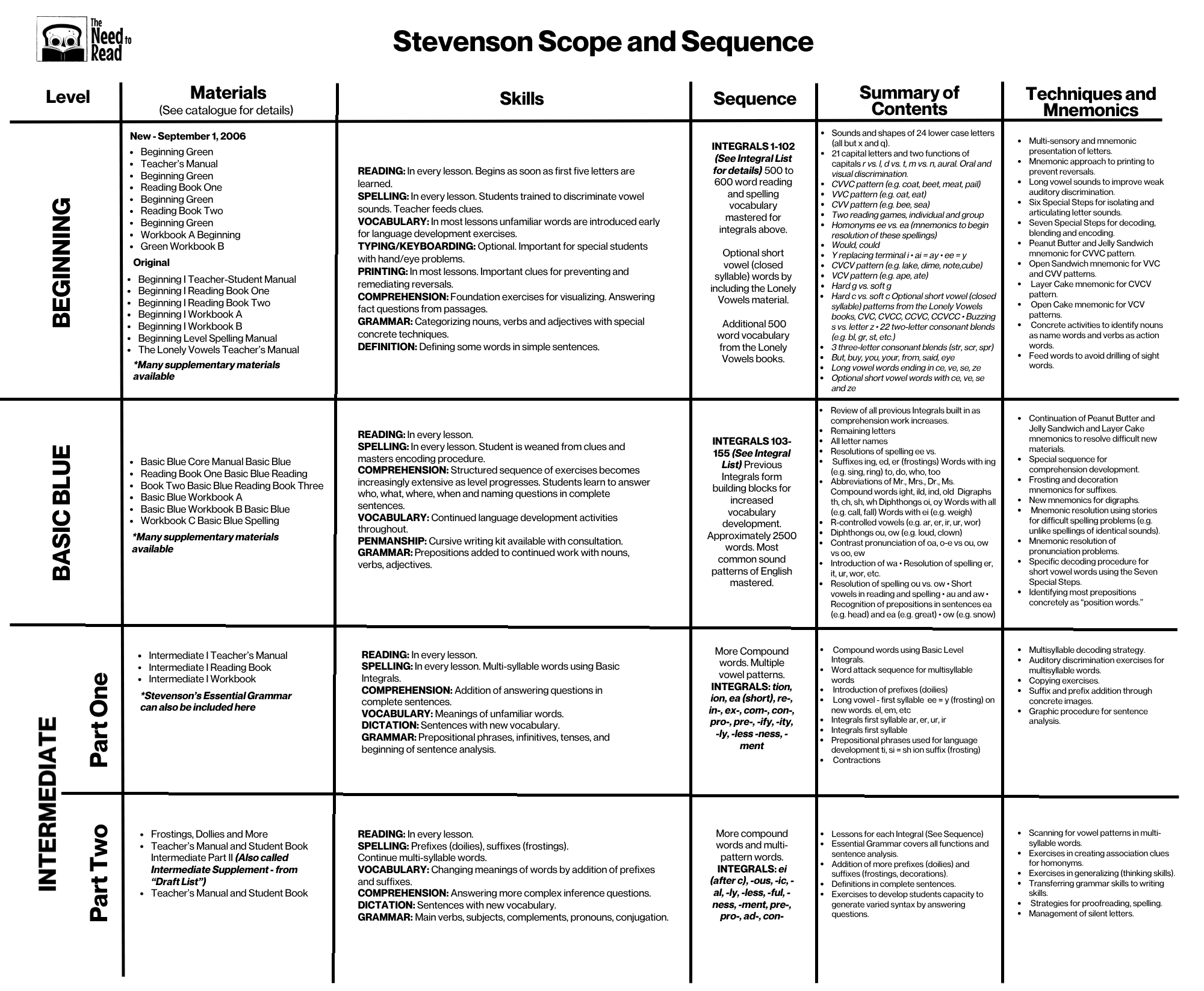
Every skill, every level, all in one place.
If you have ever wondered exactly what the Stevenson program teaches and in what order, this is the document you need. The Stevenson Scope and Sequence gives you a complete overview of all three levels — Beginning, Basic Blue and Intermediate — laid out clearly so you can see the full progression from foundational phonics all the way through advanced grammar and comprehension.
For each level you will find the exact materials needed, the skills covered in reading, spelling, vocabulary, grammar and comprehension, the sequence of integrals students work through, a detailed summary of what is taught, and the specific techniques and mnemonics used at each stage.