

The IEP Guide for Parents: What It Is, How to Get One & What to Ask For
The IEP process can feel overwhelming, confusing, and even intimidating. This guide is here to change that, so you can walk into every meeting informed, prepared, and ready to advocate powerfully for your child.

You Shouldn't Have to Figure This Out Alone
If you've recently heard the term "IEP" for the first time or if you've been in the IEP process for years and still feel like you're not quite sure what's happening, you are in very good company.
The Individualized Education Program process is one of the most important systems available to families of children with learning differences. It can unlock specialized instruction, targeted support, legal protections, and resources that can genuinely change the trajectory of a child's education.
It can also feel like a maze of acronyms, legal language, and meetings where everyone in the room seems to know something you don't.
We hear this from families all the time. And it is exactly why we wrote this guide.
The IEP process was designed to serve your child. But it works best when parents understand it. Because an informed, engaged parent is the single most powerful advocate a child with a learning difference can have.
So let's break it down. All of it.
What Is an IEP?
An IEP (Individualized Education Program) is a legally binding document that outlines the specialized education plan for a child with a disability that affects their ability to access the general education curriculum. It is created collaboratively by a team that includes the child's parents, teachers, and school specialists. And once it is signed, the school is legally required to implement every element of it.
The IEP serves several purposes simultaneously:
It documents your child's current performance. Where are they right now: academically, functionally, socially compared to where they need to be?
It sets measurable annual goals. What specific, observable progress should your child make over the next year?
It describes the services your child will receive. What specialized instruction, therapy, accommodations, and supports will the school provide and for how long, how often, and by whom?
It outlines how progress will be measured. How will the school track whether your child is actually making the progress the IEP describes?
It protects your child's rights. Once an IEP is in place, your child has legal entitlement to the services it describes. The school cannot simply decide to stop providing them.
For children with dyslexia, auditory processing disorder, ADHD, dysgraphia, and other language-based learning differences, an IEP can be the doorway to structured literacy instruction, smaller group settings, extended time, assistive technology, and a host of other supports that make a measurable difference.
Who Qualifies for an IEP?
IEPs are governed by a federal law called the Individuals with Disabilities Education Act (IDEA). Under IDEA, a child qualifies for an IEP if they meet two criteria:
1. They have one or more of the 13 qualifying disability categories recognized by IDEA.
For most struggling readers, the relevant categories are:
Specific Learning Disability (SLD) This is the category that covers dyslexia, dysgraphia, and dyscalculia. It is the most commonly used category for children with reading and writing difficulties.
Other Health Impairment (OHI) This is often used for children with ADHD whose attention difficulties affect their educational performance.
Speech or Language Impairment Sometimes used for children with auditory processing disorder or significant language-based challenges.
2. The disability must adversely affect their educational performance meaning it must be getting in the way of their ability to access and benefit from the general education curriculum.
A child can have a diagnosed learning difference and still not qualify for an IEP if the school determines it is not significantly impacting their educational performance.
This is one of the areas where parent advocacy matters most and we'll come back to it.

The Difference Between an IEP and a 504 Plan
Many parents encounter both of these terms and aren't sure which applies to their child. Here's a clear breakdown:
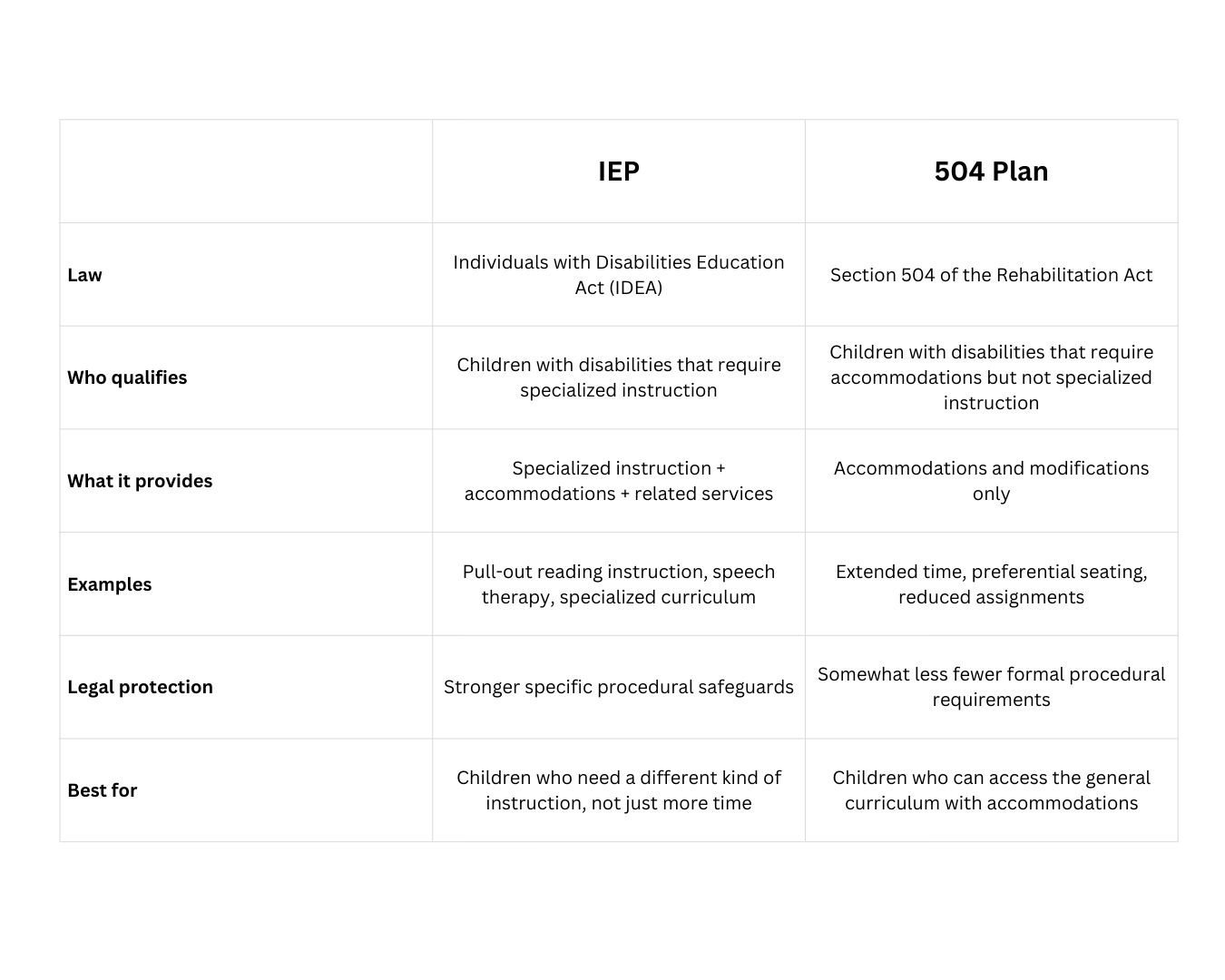
For most children with dyslexia, APD, or dysgraphia who need structured literacy instruction, an IEP is more appropriate than a 504 plan because what they need isn't just extra time. They need a fundamentally different approach to instruction. A 504 plan cannot mandate specialized reading instruction the way an IEP can. If your child currently has a 504 plan and is still significantly struggling, it may be worth requesting a full evaluation to determine whether they qualify for an IEP instead.
How to Request an IEP Evaluation: Step by Step
Here is exactly how the process works from your first request to your child's first IEP meeting.
Step 1: Submit a Written Request for Evaluation
You have the legal right to request a special education evaluation for your child at any time. You do not need a doctor's referral. You do not need to wait for the school to suggest it. You do not need a formal diagnosis first.
Your request must be in writing. An email is perfectly acceptable and is actually preferable because it creates a clear, timestamped record. Address it to your child's principal or the school's special education coordinator. Keep it simple and direct. Here is a sample:
Dear [Principal/Special Education Coordinator name],
I am writing to formally request a comprehensive special education evaluation for my child, [child's name], currently in [grade] at [school name].
I have concerns about [briefly describe: reading difficulties, writing challenges, attention, etc.] that I believe may be affecting their ability to access the general education curriculum. I am requesting this evaluation under the Individuals with Disabilities Education Act (IDEA).
Please confirm receipt of this request and provide me with the required consent forms. I look forward to hearing from you.
Sincerely, [Your name] [Your contact information]
Keep a copy of this email. Note the date you sent it. This matters because the clock on the school's legal response timeline starts the moment they receive your request.
Step 2: The School Responds
Once your written request is received, the school has a set timeframe to respond typically 60 calendar days, though this varies by state. Some states have shorter timelines, so it's worth checking your specific state's requirements.
The school will send you a Prior Written Notice (PWN) a formal document explaining whether they agree to evaluate your child, and why. If they agree, they will also send you a consent form that you must sign before the evaluation can begin.
If the school refuses to evaluate: They must provide you with a written explanation of why. You have the right to disagree with this decision and to pursue further action including mediation or a due process hearing. We'll cover this in the rights section below.
Step 3: The Evaluation
Once you've signed the consent form, the school has 60 days (again, check your state's specific timeline) to complete a comprehensive evaluation.This evaluation is free of charge to you. It will be conducted by a team of school professionals which may include a school psychologist, speech-language pathologist, special education teacher, and other specialists depending on your child's needs.
The evaluation should be comprehensive meaning it assesses all areas related to the suspected disability, not just one or two. For a child with suspected reading difficulties, this should include assessment of:
Cognitive ability (IQ)
Academic achievement (reading, writing, math)
Phonological processing
Language processing
Processing speed
Working memory
You have the right to provide information to the evaluation team including your own observations, any private evaluations you've obtained, and teacher reports. Don't be passive in this step. Your input matters and is legally required to be considered.
Step 4: The Eligibility Meeting
After the evaluation is complete, the school will schedule an eligibility meeting sometimes called an IEP team meeting or MDT (Multidisciplinary Team) meeting. This is where the team reviews the evaluation results together and determines whether your child qualifies for special education services.
You are a full member of this team. You have an equal voice in the eligibility decision. If your child is found eligible, the team will proceed to develop the IEP either at this same meeting or at a follow-up meeting scheduled within 30 days.
If your child is found not eligible and you disagree with that determination, you have the right to request an Independent Educational Evaluation (IEE) at the school's expense. More on this below.
Step 5: The IEP Is Developed
The IEP team which includes you develops the written IEP document together. This is not something the school presents to you as a finished product for you to sign. You are a participant in creating it, not a recipient of it. Once the IEP is finalized and signed, services must begin without unreasonable delay.

What Should Be in Your Child's IEP
A legally compliant IEP must contain specific components. Here's what to look for and what questions to ask about each one.
Present Levels of Academic Achievement and Functional Performance (PLAAFP)
This section describes where your child is right now their current strengths, challenges, and performance levels across relevant areas.
What to look for: Specific, measurable data not vague statements like "reads below grade level." It should include actual scores, grade equivalents, and percentile rankings from the evaluation. It should describe both what your child can do and where the gaps are.
Questions to ask:
"Can you walk me through each of these scores in plain language?"
"How does this compare to where my child should be at this grade level?"
"What specific areas are most impacting their ability to access the curriculum?"
Special Education and Related Services
This section describes exactly what services your child will receive including what type of instruction, how many minutes per week, in what setting, and provided by whom.
What to look for: Specificity. The IEP should state exactly how many minutes per week of specialized reading instruction your child will receive, whether it will be in a small group or one-on-one setting, and whether it will be delivered by a certified special education teacher or a reading specialist.
Questions to ask:
"What specific reading program or approach will be used for my child's instruction?"
"Is this approach evidence-based and aligned with the science of reading?"
"How many students will be in my child's intervention group?"
"What are the qualifications of the person delivering the instruction?"
Accommodations and Modifications
Accommodations are changes to how your child accesses learning extended time, preferential seating, reduced assignment length. Modifications are changes to what your child is expected to learn a reduced curriculum or alternate grade-level standards.
What to look for: Accommodations that directly address your child's specific challenges. For a child with dyslexia, this might include extended time on tests, text-to-speech technology, oral responses in place of written ones, and reduced copying from the board.
Questions to ask:
"Are these accommodations available in all classes and settings — including testing?"
"Will my child receive these same accommodations on state standardized tests?"
"Are there any accommodations we haven't discussed that might benefit my child?"
Least Restrictive Environment (LRE)
IDEA requires that children with disabilities be educated in the least restrictive environment possible meaning alongside their non-disabled peers to the maximum extent appropriate.
What to look for: A clear description of how much time your child will spend in the general education classroom versus receiving specialized instruction in a separate setting. The IEP must explain why any time outside the general education classroom is necessary.
Questions to ask:
"Why is this particular setting recommended for my child?"
"What would need to change for my child to spend more time in the general education classroom?"
"How will my child's teachers communicate about their progress across settings?"
Transition Planning
For students age 16 and older, the IEP must include a transition plan addressing post-secondary education, vocational training, and independent living goals. If your child is approaching this age, make sure the transition section is specific, realistic, and genuinely reflects your child's interests, strengths, and goals.
Your Legal Rights as a Parent: The Complete Picture
This is the section we want every parent to read twice. Because knowing your rights is not about being adversarial with your child's school it is about being the informed, effective advocate your child needs you to be.
The Right to Participate as an Equal Team Member
You are not a guest at IEP meetings. You are a required member of the IEP team with an equal voice in all decisions. Schools cannot hold IEP meetings without you unless they have made repeated documented attempts to include you and you have declined.
The Right to Request an Evaluation at Any Time
As described above you can request a comprehensive evaluation in writing at any time. The school must respond in writing and must provide a clear reason if they decline.
The Right to an Independent Educational Evaluation (IEE)
If you disagree with the school's evaluation either its findings or the way it was conducted you have the right to request an Independent Educational Evaluation conducted by a qualified evaluator outside the school system. The school must either pay for this evaluation or file for a due process hearing to show that their evaluation was appropriate. This is a powerful right that many parents don't know they have. A private neuropsychological evaluation can sometimes identify learning differences that a school evaluation missed or underestimated.
The Right to Receive All Documents in Advance
You have the right to receive a copy of your child's evaluation report and any proposed IEP documents before the meeting not at the meeting. You should never be handed a stack of documents and asked to make decisions about them in real time. Ask for everything in advance, in writing.
The Right to Bring Support
You can bring anyone you choose to an IEP meeting a spouse or partner, a trusted friend, an educational advocate, or an attorney. You do not need to ask permission. Simply inform the school in advance that you will be bringing a guest.
The Right to Record the Meeting
In most states, you have the right to record IEP meetings but requirements vary. Check your state's specific laws. If recording is permitted, inform the school in advance that you intend to do so.
The Right to Disagree and Request Changes
You are never required to sign an IEP you disagree with. You can request changes, ask for additional time to review, or sign the document with written objections noted. Services can begin for the parts you agree with while disagreements are resolved.
The Right to Mediation and Due Process
If you and the school cannot resolve a disagreement, you have the right to request mediation a free, voluntary process facilitated by a neutral third party. If mediation doesn't resolve the issue, you have the right to file for a due process hearing a more formal legal proceeding. Both options are available at no cost to you.
The Right to Annual Review and Triennial Reevaluation
Your child's IEP must be reviewed at least once per year. Your child must be fully reevaluated at least every three years to determine whether they still qualify for services and whether the current plan is appropriate. You can request either of these sooner if you believe circumstances have changed.
The Right to Prior Written Notice
Any time the school proposes to change or refuses to change your child's identification, evaluation, educational placement, or services, they must provide you with written notice explaining their reasoning. This is called Prior Written Notice (PWN), and it is your documentation trail if you ever need to escalate a disagreement.
Questions to Ask at Every IEP Meeting
Print this list. Bring it with you. Use it every single time.
About the goals:
Are these goals based on my child's specific evaluation data?
Are these goals ambitious enough to close the gap, or just maintain the status quo?
How and how often will progress be measured and reported to me?
About the instruction:
What specific reading program or approach will be used?
Is it evidence-based and aligned with the science of reading and structured literacy?
Who will deliver the instruction and what are their qualifications?
How many students will be in my child's group?
About the accommodations:
Will these accommodations apply in all settings including testing?
Are there accommodations we haven't considered that might help?
About placement:
Why is this placement recommended?
What would need to change for my child to access more of the general education curriculum?
About communication:
How will you communicate my child's progress to me throughout the year?
Who is my primary point of contact if I have concerns?
What should I do if I feel the plan isn't working?
About next steps:
When is our next scheduled review?
What can I do at home to support what's being done at school?
Are there any outside resources or evaluations you would recommend?
A Few Things Nobody Tells You About the IEP Process
Schools are under-resourced. Most special education teams are genuinely trying to help your child but they are also managing large caseloads with limited time and funding. Coming to meetings as a collaborative partner, not an adversary, tends to get better results than coming in with an accusatory tone. Be warm. Be firm. Be persistent.
The squeaky wheel really does get the grease. Parents who follow up, document everything, and stay engaged consistently get better outcomes for their children. Not because the system rewards it but because attention follows attention.
Document everything. Every conversation, every email, every meeting. Keep a folder physical or digital with every piece of paper related to your child's education. You may never need most of it. But when you do need it, you will be very glad it's there.
You can get help. Educational advocates trained professionals who help parents navigate the IEP process can attend meetings with you, review IEP documents, and help you understand your rights. Many offer free or low-cost services. Parent Training and Information Centers (PTIs), funded by the federal government, offer free support to families in every state.
The IEP is a starting point, not a ceiling. An IEP describes the minimum the school is required to provide. It doesn't prevent you from supplementing with additional support at home including a structured reading program that reinforces and extends what's happening at school.

How the Stevenson Program Fits Into the IEP Picture
One of the most common questions we hear from families going through the IEP process is: should we wait for the school to provide everything, or should we also be doing something at home?
Our answer is always the same: don't wait.
IEP services are a critical piece of the puzzle but they are rarely enough on their own. Most children with significant reading difficulties benefit from more structured literacy practice than a school can provide within the school day. And the summer months, when IEP services typically pause, are when the most regression happens.
The Stevenson Learning Skills Reading Program was designed to work alongside school-based intervention reinforcing the same skills, filling in gaps, and giving your child the additional structured practice that makes a real difference in outcomes.
It is also scripted and parent-friendly, which means you don't need to be a reading specialist to use it effectively at home. You just need to show up consistently and you're clearly already willing to do that.
Frequently Asked Questions
What if my child has a diagnosis from a private doctor or psychologist does that automatically qualify them for an IEP? No a private diagnosis does not automatically qualify a child for an IEP. The school must conduct its own evaluation and make its own eligibility determination. However, a private evaluation is extremely valuable input that the IEP team is required to consider, and it can significantly strengthen your case.
Can I request an IEP for my preschool-aged child? Yes. IDEA covers children from birth through age 21. For children ages 3–5, IEP services are available through the school district. For children under age 3, a similar program called an IFSP (Individualized Family Service Plan) is available through Early Intervention services.
What if we move to a different state…does the IEP transfer? The new school district must provide your child with services comparable to those in the existing IEP while they conduct their own evaluation and develop a new IEP. The new district is not required to implement the previous IEP exactly, but they cannot simply discontinue services.
My child's IEP goals haven't been met after a full year. What should I do? At the annual review, ask specifically why the goals weren't met and what will change in the new IEP to address that. If you believe the school has failed to implement the IEP as written, that is a significant legal issue. Document what you know and consider consulting an educational advocate.
Can I request an IEP meeting outside of the annual review? Yes. you can request an IEP meeting at any time if you have concerns about your child's progress or if you believe the current plan needs to be revised. Submit your request in writing and keep a copy.
Is there a cost to the IEP process? No. All evaluation, IEP development, and IEP services are provided at no cost to families under IDEA. If a school attempts to charge you for any part of this process, that is not legal.
We're Here to Help
Navigating the IEP process while also trying to find the right reading support for your child is a lot. We know that. And we want you to know that you don't have to figure it all out at once or alone.
Our team at The Need to Read has worked with thousands of families in exactly this situation. We understand the Stevenson program inside and out, and we're happy to talk through how it might complement your child's IEP services, which level makes sense to start with, and what realistic progress looks like.
Reach out to us directly:
📧 info@theneedtoread.org 📞 (937) 532-0772
We respond to every message. No question is too small. This is exactly what we're here for.
At The Need to Read, our mission is simple: everyone deserves the right to read. Whether your child is just beginning the IEP journey or has been in the process for years, we're here to help. Visit theneedtoread.org to explore the Stevenson Learning Skills Reading Program or reach out to our team directly at info@theneedtoread.org or (937) 532-0772.