

What Is Structured Literacy? A Complete Guide for Parents and Educators
If you've been researching reading difficulties, you've probably seen the term "structured literacy" pop up. But what does it actually mean and why does it matter so much for struggling readers? Here's everything you need to know.

Something Is Changing in the World of Reading Education
Over the last decade, something significant has been happening in classrooms across the country.
Schools that once relied on "whole language" and "balanced literacy" approaches where children were encouraged to guess at unfamiliar words using pictures and context clues are quietly, and in some cases urgently, changing course.
Reading scores haven't been improving. Dyslexia diagnoses have been rising. And a growing body of research has been making one thing impossible to ignore:
The way we've been teaching reading isn't working for millions of children.
The approach that the research consistently points to as most effective has a name: structured literacy.
If your child is struggling to read or if you're an educator searching for an intervention that actually delivers results understanding structured literacy may be the most important thing you do this year.
So What Exactly Is Structured Literacy?
Structured literacy is a comprehensive, evidence-based approach to teaching reading and writing that is grounded in the science of how the brain actually learns to decode language.
The term was coined by the International Dyslexia Association to describe a specific set of instructional principles that research has consistently shown to be the most effective way to teach reading particularly for students with dyslexia, auditory processing challenges, and other language-based learning differences.
But here's what's important to understand: structured literacy isn't just for children with dyslexia. Research shows it is more effective for all learners including those who would have learned to read anyway through less rigorous instruction. It just happens to be the only approach that reliably works for the children who need it most.
At its core, structured literacy teaches students to understand and work with the structure of language itself from the smallest units of sound all the way up to full sentences and texts. It is organized, logical, and leaves nothing to chance.
1. Phonology
The study of the sound system of language. Students learn to hear, identify, and manipulate the individual sounds (phonemes) in words. This is called phonemic awareness and it is the single strongest predictor of reading success.
Before a child can connect letters to sounds on a page, they need to be able to hear those sounds clearly in their mind. This is where structured literacy begins.
2. Sound-Symbol Association
This is phonics the relationship between letters (or letter combinations) and the sounds they represent. In structured literacy, these relationships are taught explicitly and systematically, in a carefully planned sequence, until they become automatic.
Nothing is assumed. Nothing is left to be "figured out." Every pattern is taught directly.
3. Syllable Instruction
English has six types of syllables, each with its own rules. Structured literacy teaches students to recognize and decode each type giving them a powerful tool for breaking apart long, unfamiliar words rather than guessing or skipping them.
4. Morphology
The study of word parts prefixes, suffixes, base words, and roots. Understanding that "un-" means "not," or that "-tion" turns a verb into a noun, dramatically expands a student's ability to read and understand vocabulary they've never seen before.
5. Syntax
The rules that govern how words are arranged in sentences. Structured literacy helps students understand sentence structure both to support reading comprehension and to build stronger writing skills.
6. Semantics
The meaning of language vocabulary, figurative language, and how context shapes understanding. Structured literacy ensures that students don't just decode words, but understand what they mean.
The 5 Principles That Make It Work
It's not just what structured literacy teaches it's how it teaches it. These five principles are what separate structured literacy from other reading approaches:
Explicit
Every concept is directly and clearly taught. Teachers don't hint, suggest, or hope students will figure it out. They show, model, explain, and confirm understanding at every step.
This matters enormously for students with dyslexia, who cannot rely on incidental learning the way many of their peers can.
Systematic and Sequential
Skills are introduced in a logical, carefully planned order. Each new concept builds on what came before. Nothing is taught out of order or skipped because it seems too basic.
This creates a solid foundation no gaps, no shaky ground.
Cumulative
New learning is always connected to previous learning. Skills practiced earlier are regularly revisited and reinforced. This is especially important for students who struggle with working memory, because repetition and connection are how lasting learning happens.
Multisensory
Students use multiple pathways simultaneously hey see, hear, say, and write. This multi-channel approach creates stronger and more durable memory connections in the brain.
A child learning the letter "b" in a structured literacy classroom isn't just looking at it on a page. They're tracing it, saying its sound, tapping it out, connecting it to a visual cue. Multiple inputs, one powerful outcome.
Diagnostic and Responsive
The teacher constantly monitors student understanding and adjusts instruction accordingly. No student is left to flounder while the class moves on. Progress is measured, tracked, and responded to in real time.
How Is This Different From How Reading Has Been Taught?
This is where many parents and educators have an "aha" moment because what structured literacy describes is fundamentally different from what many of us experienced in school, and what many children are still experiencing today.
For decades, the dominant approach in many classrooms was called balanced literacy or whole language reading instruction. This approach encouraged children to:
Use picture clues to guess unfamiliar words
Use context to figure out what a word might be
Memorize high-frequency words by sight
Read books at their "just right" level and absorb reading skills through exposure
The underlying assumption was that reading was a natural process that with enough exposure to books and a rich literacy environment, most children would learn to read the way they learned to speak.
The research has been clear for decades: that assumption is wrong.
Reading is not natural. It is a technology that the human brain has to be explicitly taught to use. And when instruction relies on guessing strategies instead of decoding skills, millions of children particularly those with dyslexia are set up to fail.
Structured literacy replaces guessing with decoding. It replaces exposure with explicit instruction. And it replaces hope with a reliable, replicable process.

What Does a Structured Literacy Lesson Actually Look Like?
This is a question we hear a lot — and it's a great one, because understanding what it looks like in practice helps both parents and educators know what to look for.
A structured literacy lesson typically includes:
Phonemic Awareness Practice The lesson often begins with oral exercises — no reading required. Students might segment words into sounds, blend sounds together, or identify the odd-one-out in a set of words. This keeps the phonological foundation strong.
Review of Previously Learned Concepts Before introducing anything new, students revisit what they've already learned. This cumulative review is not wasted time — it is the engine of retention.
Explicit Introduction of New Concept The teacher introduces one new concept clearly and directly. They explain what it is, why it works, and how it fits with everything the student already knows.
Guided Practice Students practice the new concept with the teacher, receiving immediate feedback. Errors are corrected gently and clearly in the moment — not later, not with a grade on a paper.
Reading and Writing Application Students apply what they've learned by reading words, sentences, and eventually texts that use the target pattern — and by writing using the same skills. Both directions reinforce the same neural connections.
Multisensory Reinforcement Throughout the lesson, multiple senses are engaged. Students might tap out syllables, trace letters, use manipulatives, or connect sounds to visual mnemonic cues.
A good structured literacy lesson is brisk, focused, and highly interactive. Students are actively engaged throughout — not passively receiving information.
Why Does It Work So Well for Students With Dyslexia?
Dyslexia is fundamentally a phonological processing challenge the brain has difficulty connecting the sounds of language to their written symbols. This means that any reading approach that relies on guessing, memorization, or whole-word recognition will consistently fail dyslexic learners.
Structured literacy works because it directly addresses the root cause.
By systematically building phonological awareness, teaching sound-symbol relationships explicitly, using multisensory reinforcement, and providing cumulative review, structured literacy creates new neural pathways that allow dyslexic readers to decode language reliably.
This isn't a workaround. It isn't accommodation. It is the actual solution.
Research from institutions including the National Institutes of Health and the Yale Center for Dyslexia and Creativity has shown that with intensive, structured literacy instruction, dyslexic readers' brains actually change developing the same reading pathways that typical readers use naturally. The brain is adaptable. The right instruction makes the difference.
What Parents Need to Know
If your child is struggling to read, here are the most important questions to ask about any reading program or intervention they're receiving:
Is it explicit? Are skills being directly taught or is your child expected to figure them out?
Is it systematic? Is there a clear, logical sequence or is instruction jumping around based on what comes up in classroom reading?
Is it multisensory? Are multiple senses being engaged or is your child just staring at text on a page?
Is it cumulative? Are previously learned skills being regularly revisited and reinforced?
Is progress being tracked? Is someone measuring your child's progress regularly and adjusting the approach if it isn't working?
If the answer to any of these is no, or "I'm not sure" it's worth asking more questions. Your child deserves instruction that is built around how their brain actually learns.

What Educators Need to Know
The science of reading has been settled for longer than many people realize. The research supporting structured literacy is not new but its implementation in schools has been frustratingly slow.
If you are a teacher or reading specialist who has been trained in balanced literacy or guided reading approaches, this isn't about blame. It's about what we now know and what our students deserve.
Structured literacy professional development is increasingly available, and the shift is worth making. The students who benefit most are your most vulnerable readers the ones who have been trying the hardest and getting the least return on that effort.
A structured literacy program with a clear scope and sequence, a scripted format, and built-in multisensory components makes implementation significantly more accessible. Even for educators who are new to this approach.
The Stevenson Reading Program and Structured Literacy
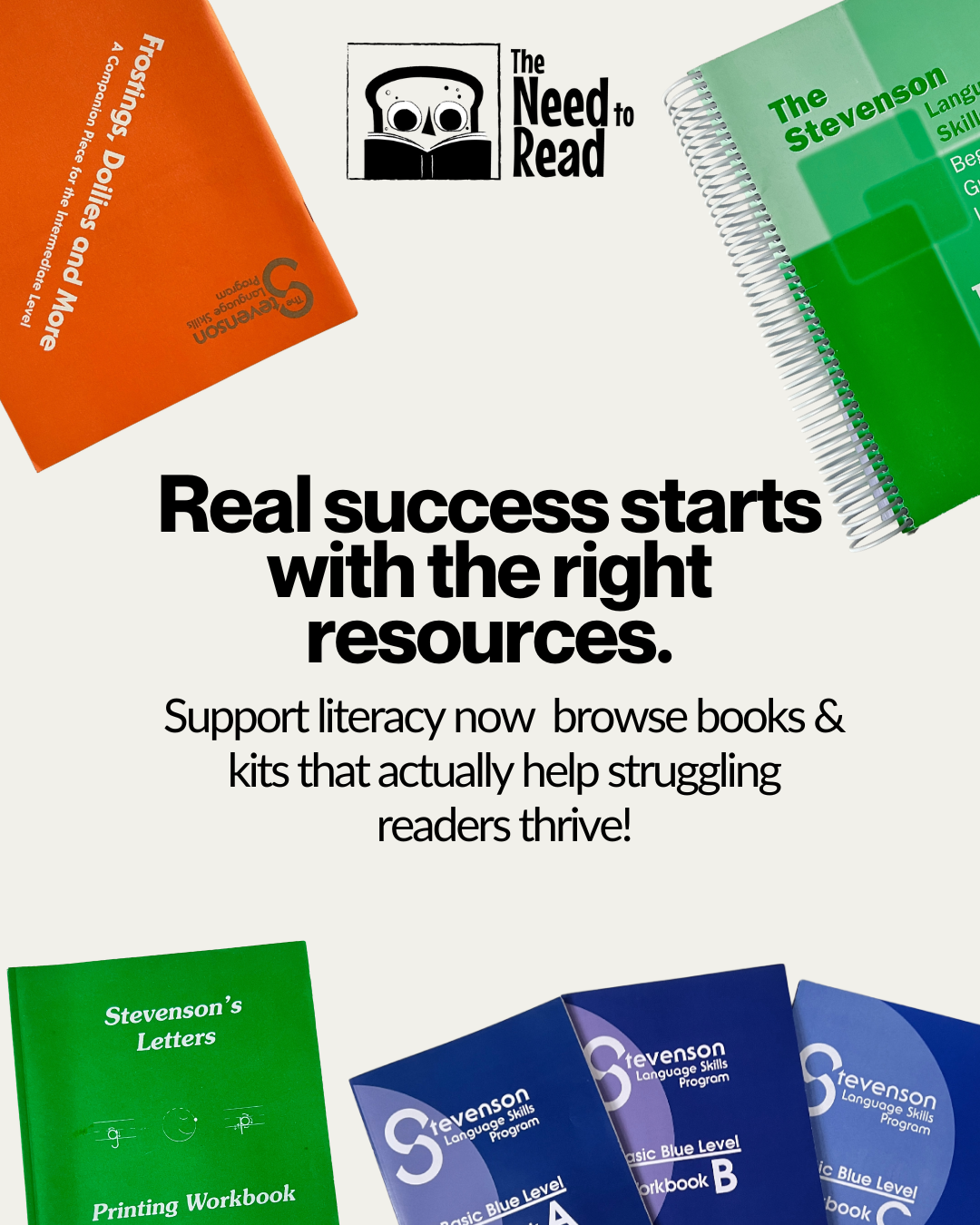
The Stevenson Learning Skills Reading Program was built on every principle of structured literacy before the term was even widely used.
Created by educator Nancy Richardson Stevenson, the program features:
A scripted, easy-to-follow format that makes explicit instruction accessible for parents and educators alike — no specialist degree required.
A clear, sequential scope across three levels: Green (foundational), Blue (intermediate), and Peach (advanced) so there are no gaps and no guesswork about where to start.
Extensive mnemonic-based memory cues woven throughout, giving students with weak phonological memory powerful visual anchors to connect sounds and symbols.
A genuinely multi-sensory approach students hear, see, say, and write at every stage of the program.
A built-in Decision Guide to help parents and educators identify the right starting level for each individual student.
It is one of the most accessible, thoroughly structured, and parent-friendly implementations of structured literacy available — and it was designed specifically for the students who need it most.
The Bottom Line
Structured literacy is not a trend. It is not a buzzword. It is the result of decades of rigorous research into how the human brain learns to read and what happens when that process goes wrong.
For the 1 in 5 children who struggle with reading, it is not one option among many. It is the approach that works. And for all children, it builds a stronger, more reliable reading foundation than any approach that relies on guessing or exposure.
If your child is struggling or if you are an educator watching students struggle the answer is structured literacy. The question is just where to start.
We can help with that.
Ready to Get Started?
The Stevenson Learning Skills Reading Program brings the full power of structured literacy to parents and educators in a format that is clear, scripted, and proven. No specialist training required. No guesswork. Just a well-built program designed for the students who need it most.
Visit our store at theneedtoread.org/store to explore our program levels and find the right fit for your student.
Not sure which level to start with? Take our free Decision Guide at theneedtoread.org it takes just a few minutes and gives you a clear path forward. Questions? Our team is here. Reach us at info@theneedtoread.org or (937) 532-0772.
Frequently Asked Questions
Is structured literacy only for children with dyslexia?
No. structured literacy is effective for all learners. Research shows it produces stronger reading outcomes across the board. It is simply essential for students with dyslexia, rather than just beneficial.
How is structured literacy different from phonics?
Phonics is one component of structured literacy specifically the sound-symbol relationship piece. Structured literacy is broader, covering phonological awareness, syllable types, morphology, syntax, and semantics in addition to phonics.
My child's school uses balanced literacy. What should I do?
Start by asking your child's teacher what reading intervention your child is receiving and whether it includes explicit, systematic phonics instruction. If the answer is vague or unsatisfying, you have the right to request a formal evaluation and advocate for a more structured approach. Supplementing at home with a structured literacy program is also a highly effective option.
How long does it take to see results with structured literacy?
Most students show measurable progress within 8–12 weeks of consistent, structured literacy instruction. Students with more significant reading difficulties may take longer, but progress is typically visible and trackable throughout the process.
Can parents implement structured literacy at home?
Absolutely. Programs like the Stevenson Reading Program are specifically designed to be implemented by parents with a scripted format that removes the guesswork and makes high-quality structured literacy instruction accessible without specialist training.
At The Need to Read, our mission is simple: everyone deserves the right to read. The Stevenson Learning Skills Reading Program has helped thousands of struggling readers find their footing and we're here to help yours do the same.
Visit theneedtoread.org to learn more.