

10 Early Signs of Dyslexia in Children Every Parent Should Know
Is your child struggling with reading and you're not sure why? You're not imagining it, and you're not alone. Here's what to look for, and what to do next.
It usually starts quietly. Your child comes home from school a little deflated. Homework takes twice as long as it should. You notice them squinting at the page, guessing at words, or losing their place over and over again.
You tell yourself it's just a phase. They'll catch up.
But weeks turn into months, and the gap keeps growing. And deep down, you start to wonder: Is something else going on?
If that sounds familiar, this post is for you.
Dyslexia is the most common learning difference in the world, affecting an estimated 1 in 5 children. Yet most families spend years searching for answers before they ever hear the word. Not because they aren't paying attention but because the signs of dyslexia in children are often misunderstood, overlooked, or mistaken for something else entirely. Here's what you actually need to know.
What Is Dyslexia, Really?
Before we get to the signs, let's clear up the biggest myth.
Dyslexia does not mean seeing letters backwards.
That's probably the most widespread misconception about dyslexia, and it keeps a lot of parents from recognizing what's actually happening with their child.
Dyslexia is a neurological, language-based learning difference. It affects how the brain processes the sounds in spoken and written language — a skill called phonological processing. When that system doesn't work the way it's supposed to, decoding written words becomes a slow, exhausting struggle regardless of how smart the child is.
And that last part is critical: dyslexia has nothing to do with intelligence. Some of the most creative, capable, and brilliant minds in history from Albert Einstein to Agatha Christie to Steven Spielberg are believed to have had dyslexia.
What dyslexia does affect is the ability to map sounds to letters, read fluently, and spell consistently. And when it goes unidentified, it doesn't just affect reading it affects confidence, self-esteem, and a child's entire relationship with learning.
The earlier it's identified, the better the outcome. Which is why knowing the signs matters so much.
The 10 Early Signs of Dyslexia in Children
These signs are organized roughly by age, but keep in mind that every child develops differently. What matters most is a pattern of multiple signs that persists over time not a single moment or a rough week.
1. Delayed Speech or Difficulty Pronouncing Words
When to watch for it: Ages 2–5
Many children with dyslexia are late talkers or mispronounce words longer than their peers. You might notice they swap sounds in words ("aminal" instead of "animal"), struggle to say longer words clearly, or have trouble being understood by people outside the family.
This happens because dyslexia affects phonological awareness the ability to hear and manipulate the individual sounds in language. And that challenge often shows up in speech before it ever shows up in reading.
2. Trouble Learning Nursery Rhymes or Recognizing Rhymes
When to watch for it: Ages 3–5
Rhyming seems simple to most kids — but it actually requires a fairly sophisticated awareness of how words are built from sounds. Children with dyslexia often struggle to hear that "cat," "bat," and "hat" share the same ending sound, or to finish a simple rhyming pattern.
If nursery rhymes, rhyming games, or songs like "Down by the Bay" cause real frustration for your child while their peers seem to enjoy them easily, that's worth noting.
3. Difficulty Learning the Alphabet, Colors, or Days of the Week
When to watch for it: Ages 4–6
This one surprises a lot of parents because it doesn't seem connected to reading. But learning the alphabet requires the brain to store and retrieve a specific sequence of abstract symbols the same kind of processing that makes reading difficult for children with dyslexia.
Children with dyslexia often take significantly longer to learn their ABCs, struggle to sing the alphabet song reliably, or have trouble remembering which letter comes next even after lots of practice.
4. Can't Identify the First Sound in a Word
When to watch for it: Ages 4–6
Ask your child: "What sound does 'dog' start with?" Most kindergartners can answer this without much trouble. Children with dyslexia often can't. Not because they aren't paying attention, but because breaking words into individual sounds (called phonemes) is genuinely difficult for their brains to do.
This is one of the clearest early markers of dyslexia, and it's something teachers can screen for easily. If your child's school hasn't assessed phonemic awareness, it's worth asking about.
5. Avoids Reading Aloud and Becomes Anxious
When to watch for it: Ages 5 and up
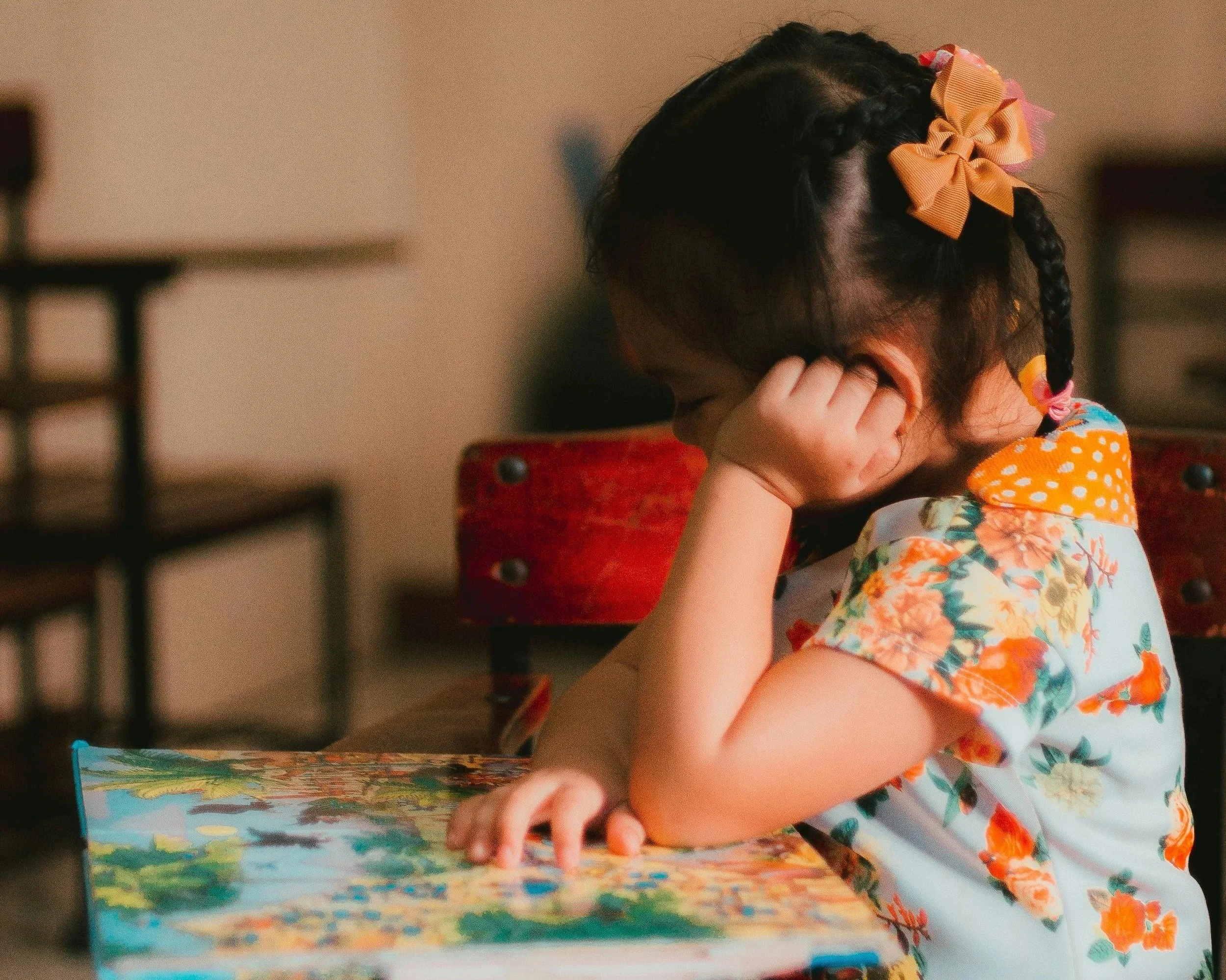
For a child with dyslexia, reading aloud in class is one of the most anxiety-inducing experiences imaginable. They know they'll struggle. They know other kids will hear. And they've likely already been corrected or embarrassed before.
Watch for signs of dread before school on days with reading activities, physical tension when asked to read, or a child who will do almost anything to get out of reading out loud.
6. Reads Very Slowly and Laboriously
When to watch for it: Ages 6 and up, especially in Grades 1–3
All beginning readers are slow readers. But children with dyslexia often remain slow long after their peers have picked up speed and fluency. Reading feels effortful even for short texts. They may lose their place constantly, reread the same line multiple times, or look physically exhausted after just a few minutes.
This is because dyslexic readers are working much harder to decode each individual word. There's no automaticity, so every word requires conscious effort.
7. Confuses Similar-Looking Letters Past Age 7
When to watch for it: Ages 6–8
It's completely normal for kindergartners and early first graders to confuse b and d, or p and q. The brain is still building its letter recognition system. But by age 7 or 8, most children have sorted this out.
If your child is still regularly confusing these letter pairs in second or third grade, it's one of the classic signs of dyslexia and a signal that their brain's phonological processing system needs more structured support.
8. Spells the Same Word Differently Every Time
When to watch for it: Ages 6 and up
Most children who struggle with spelling at least spell the same words the same wrong way consistently. Children with dyslexia often don't. They might spell "friend" as "freind" on one line, "frend" on the next, and "firend" a paragraph later.
This isn't carelessness. It reflects an unstable connection between the sounds of words and their written forms one of the core features of dyslexia. You might also notice creative but phonetically unusual spellings that seem to follow their own logic entirely.
9. Understands Everything When Listened To, But Not When Reading
When to watch for it: Ages 6 and up
This is one of the most telling signs of dyslexia, and one of the most commonly misunderstood.
Read a chapter of a book aloud to a child with dyslexia, and they may recall details with impressive precision. They can discuss the story, make predictions, and understand complex vocabulary. Hand them the same page to read independently, and it's a completely different picture.
That gap between strong listening comprehension and weak reading comprehension is a hallmark of dyslexia. The ideas are there. The language processing is there. What's missing is the bridge between print and sound.
10. Homework Takes 2–3 Times Longer Than It Should
When to watch for it: Ages 6 and up
This one tends to be the breaking point for a lot of families. A 20-minute homework assignment stretches into an hour. Tears happen. Meltdowns happen. Everyone ends the evening exhausted and frustrated. For children with dyslexia, reading and writing tasks require an enormous amount of mental energy. They're not being slow on purpose. They are genuinely working harder than their peers just to produce the same output and by the time homework comes around, many of them have already spent an entire school day doing exactly that.
If homework battles are a regular feature of your evenings and the difficulty is centered around reading or writing tasks, it's worth investigating further.
"But My Child Is Smart. Could It Still Be Dyslexia?"
Yes. Absolutely yes.
In fact, this is one of the reasons dyslexia often goes undiagnosed for so long. Bright children are remarkably good at compensating. They memorize words by sight. They use context clues to guess. They rely on their strong verbal skills to mask how hard reading actually is. Teachers may describe them as "capable but not working to their potential." Parents may hear "they just need to try harder." And the child who is already trying harder than anyone realizes, starts to believe the problem is them.
It is not them. It is an identified, well-understood neurological difference that responds extremely well to the right kind of structured instruction.
What To Do If You Recognize These Signs
Don't wait. Early intervention makes a measurable difference in outcomes, the research on this is clear and consistent.
Here's where to start:
Talk to your child's teacher. Ask specifically whether they've noticed reading difficulties and whether any screening has been done. Request to see reading fluency data.
Ask for a formal evaluation. Under the Individuals with Disabilities Education Act (IDEA), you have the right to request a free evaluation from your school district in writing, at any time. The school must respond within 60 days.
Look for a structured literacy program. The most effective reading interventions for dyslexia are explicit, systematic, multi-sensory, and sequential. Not all reading programs are built this way so make sure the one your child uses is.
Take our free Decision Guide. At The Need to Read, we've helped thousands of families find the right path forward. Our free Decision Guide at theneedtoread.org helps you identify where your child is and which level of the Stevenson Reading Program is the right place to start.
The Most Important Thing We Want You to Know
Dyslexia is not a life sentence. It is not a ceiling on what your child can achieve. It is a different way of processing language. One that, with the right support, can absolutely be overcome.
The children who struggle the most are the ones who never get that support. And the parents who make the biggest difference are the ones who like you, right now refused to stop looking for answers. Your child can learn to read. And we're here to help.
Frequently Asked Questions
At what age can dyslexia be diagnosed?
Dyslexia can be identified as early as age 5 or 6, though many children aren't formally diagnosed until age 7–8 when reading expectations become clearer. Signs can appear even earlier in speech and language development. If you have concerns, don't wait for a formal diagnosis to seek support early intervention works regardless of whether a formal label is in place.
What's the difference between dyslexia and a slow reader?
A slow reader is simply developing reading skills at a slower pace. Dyslexia is a specific neurological difference that affects phonological processing the ability to connect sounds to letters. A slow reader will typically close the gap with time and regular practice. A child with dyslexia needs structured, explicit, multi-sensory instruction to make lasting progress.
Can dyslexia be cured?
Dyslexia doesn't go away, but it absolutely can be managed and many people with dyslexia become highly skilled readers with the right support. The brain is remarkably adaptable, especially in childhood. Structured literacy programs can build new pathways that make reading much more fluent and automatic over time.
Does dyslexia only affect reading?
No. Dyslexia can also affect spelling, writing, organization, and sometimes math (especially when it involves word problems). Some children also struggle with following multi-step directions, managing time, or keeping track of sequences. These challenges are all connected to the same underlying phonological and processing differences.
Where can I get more help?
Start at theneedtoread.org. Take our free Decision Guide, explore the Stevenson Learning Skills Reading Program, or contact our team directly at info@theneedtoread.org or (937) 532-0772. We're here to help.
At The Need to Read, our mission is simple: everyone deserves the right to read. The Stevenson Learning Skills Reading Program has helped thousands of struggling readers children and adults find their footing. Visit theneedtoread.org to learn more.